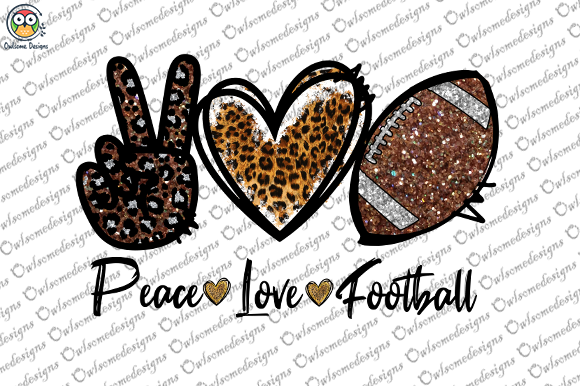
Peace Love Football Sublimation: An Embroidery Review
As a designer who bridges the gap between digital graphics and tactile needlework, I approach every new asset with a specific question: will this actually translate to thread? When evaluating the Peace Love Football Sublimation design, my perspective shifts from pure graphic appreciation to practical application. While this asset is marketed as a high-resolution PNG for sublimation, its bold layout and thematic clarity make it a compelling candidate for mixed-media projects and digitizing inspiration. For embroidery designers, Etsy sellers, and makers, understanding how to leverage this graphic within a stitch-based workflow is essential for creating unique handmade products that stand out in a saturated market.
First Impressions and Visual Translation
My initial assessment of Peace Love Football Sublimation focuses on its visual hierarchy. The design combines iconic symbols—the peace sign, heart, and football—into a cohesive badge-style layout. From a graphic design standpoint, the 300 DPI resolution ensures crisp edges, which is vital if you are using this as a base for digitizing or pairing it with embroidery. The transparent background is a significant advantage, allowing for seamless integration into printable mockups or layering over fabric textures without tedious editing.
However, an embroidery file requires different considerations than a print file. Looking at the shapes, I immediately see potential for a combination machine embroidery design. The solid blocks of color in the football and heart suggest natural areas for fill stitch or applique design, while the outline elements could be rendered in satin stitch or running stitch. Because SVG files cannot be created for this specific asset due to parsing limitations, you cannot simply convert this PNG directly into stitches. Instead, treat this high-quality graphic as a premium template. It provides the exact proportions and spacing needed to manually digitize a professional-grade version or to use as a precise placement guide for hybrid crafting techniques.
Real-World Application: The Custom Sweatshirt Scenario
To truly judge the utility of Peace Love Football Sublimation, I applied it to a real-life scenario: creating a custom apparel piece for a boutique client targeting football moms and fans. The goal was a vintage-inspired sweatshirt that felt authentic rather than mass-produced. In this context, the design serves two distinct purposes depending on your production method.
If utilizing a mixed-media approach, the sublimation aspect allows for vibrant, full-color backgrounds that would be impossible to achieve with thread alone. I envision using the Peace Love Football Sublimation graphic to create a colorful backdrop on polyester-blend fleece, then adding embroidered text or borders on top. This hybrid technique reduces stitch density significantly, preventing the stiff, bulletproof feel that dense embroidery can sometimes cause on soft garments. For clients who prefer 100% cotton where sublimation isn't an option, the graphic acts as a perfect digitizing map. The clear separation of elements makes it easy to assign thread colors and determine stabilizer requirements before the needle ever touches the fabric.
From a business perspective, this versatility increases product value. Customers appreciate the depth that comes from combining print and stitch. Whether you are selling finished goods at a craft fair or listing digital embroidery file adaptations on Etsy, demonstrating this level of thoughtful execution builds buyer engagement and trust.
Navigating Fabric Constraints and Hoop Sizes
While the aesthetic of Peace Love Football Sublimation is versatile, technical execution requires careful planning. Not every fabric or hoop size will yield a professional result. Based on my experience with similar badge-style graphics, here is where caution is necessary:
- Stretchy Fabrics: If adapting this design for knit jerseys or stretchy t-shirts, the combination of sublimation ink and embroidery tension can cause distortion. Always test on scrap fabric first with appropriate cut-away stabilizer to ensure the registration remains true.
- Small Hoop Sizes: The intricate details where the peace sign intersects with other elements may get lost in a 4x4 hoop. If resizing is necessary, verify that critical lines remain distinct. Sometimes, simplifying the design for smaller hoops preserves the integrity better than forcing a complex layout.
- Textured Surfaces: On heavily textured fabrics like terry cloth or boucle, fine details from the original PNG may disappear. In these cases, use the graphic as a reference to create a bolder, more simplified embroidery version with thicker satin stitches.
- Dark Fabrics: Remember that sublimation does not work on dark fabrics without specialized white-toner transfers or glitter vinyl bases. If working with navy or black garments, rely entirely on embroidery or screen-print transfers, using the PNG solely as a visual guide.
Understanding these limitations prevents wasted materials and ensures your finished product meets commercial standards. A failed test on scrap fabric is cheap; a ruined customer order is costly.
Elevating Brand Consistency and Product Value
In the competitive landscape of crafts and graphics, consistency is what separates hobbyists from established brands. Peace Love Football Sublimation offers a unified visual theme that can extend across multiple product lines. Imagine offering a matching set: a sublimated tote bag design for game day essentials, a personalized gift like an embroidered patch for denim jackets, and nursery decor featuring a softer, pastel-adapted version of the same motif.
This cohesion creates recognition. When customers see your work, they should immediately associate it with quality and intentional design. Using high-resolution assets like this one ensures that your printable mockups look just as professional as your physical samples. For digital product sellers, providing accurate, high-DPI previews reduces customer service inquiries and returns. For apparel decorators, the ability to resize the source image to suit specific garment placements means you never have to compromise on proportion. Ultimately, leveraging this asset effectively signals to buyers that you understand both design principles and production realities.
Essential Designer Notes for Success
Before incorporating Peace Love Football Sublimation into your next embroidery project or commercial listing, run through this practical checklist to ensure success:
- Verify Licensing: Always confirm whether the license permits commercial use for both physical handmade products and digital design assets. Terms vary, and protecting your business starts with compliance.
- Test Contrast: View the design in black and white before stitching or printing. If the values are too similar, the design will read as muddy on fabric. Adjust thread colors or ink saturation to maintain definition.
- Check Stabilizer Pairing: Match your stabilizer to the fabric weight and stitch density. A design intended for lightweight baby embroidery needs tear-away or wash-away support, while heavy denim requires robust cut-away backing.
- Mockup Realistically: Use the transparent PNG to create realistic mockups that show texture and scale. Avoid flat, digital-only presentations. Show the design on a wrinkled sweatshirt or a draped towel to set accurate customer expectations.
- Inspect Small Details: If digitizing from this PNG, zoom in to check corner transitions. Sharp angles in vector art often need rounding in embroidery to prevent thread breaks and needle damage.
By treating Peace Love Football Sublimation as a foundational design asset rather than just a standalone image, you unlock greater creative and commercial potential. Whether you are crafting a holiday gift, stocking your small shop product line, or expanding your digital offerings, this review confirms that with the right technical approach, this design delivers both aesthetic appeal and practical viability for serious makers.